
Colchester City Council Preferred Options Local Plan Regulation 18 Consultation 2025
2. Vision and approach to Local Plan View representations
Approach to the Local Plan
2.1 Section 19(1A) of the Planning and Compulsory Purchase Act 2004 requires local planning authorities to include in their Local Plans "policies designed to secure that the development and use of land in the local planning authority's area contribute to the mitigation of, and adaptation to, climate change".
2.2 The way places are planned, designed and built can have a significant influence over health and wellbeing. All development should be designed to provide opportunities for healthy lifestyles and contribute to the creation of healthier and inclusive communities and help to reduce health inequalities for people of all ages and abilities through placemaking. The Council will continue to work with partners and health providers to improve and promote healthier and active lifestyles for our residents and communities. Health and wellbeing outcomes are embedded throughout the policies in the Local Plan.
2.3 The Local Plan is holistic and integrated, it addresses the climate emergency, biodiversity and the environment, health and wellbeing and the cost of living crisis. All policies individually and cumulatively (the overall Local Plan) have been considered in this context.
2.4 The Environment Act 2021 puts the duty to enhance biodiversity into law. The Act establishes a strengthened biodiversity duty on public authorities, which states that public authorities must consider what they can do to conserve and enhance biodiversity.
2.5 Protecting and enhancing biodiversity, nature recovery and addressing the climate emergency are not stand-alone topics, they are intertwined and embedded in all aspects of planning. A key purpose of the new Local Plan to 2041 has been to enhance Colchester's green network and waterways and incorporate the numerous themes of the 'planning for a better environment' agenda, such as air quality, biodiversity net gain, climate change adaptation and mitigation and net zero, flooding and coastal erosion, green and blue infrastructure, greenspace provision, Habitat Regulations, Local Nature Recovery Strategy, natural capital and environmental net gain, protected sites and species and water quality and resources.
2.6 The effects of climate change are already being experienced – more storms and heavy rainfall coupled with water stress, heatwaves and higher temperatures. It is right that the Local Plan includes policy requirements for net zero homes and buildings, and climate change adaptation.
2.7 Essex is the most water stressed county in the country. The situation is expected to get worse due to climate change, population growth and the need to restore, protect and enhance the natural environment. Although Essex is one of the driest places in the country, there are also areas at very high flood risk from the sea, rivers and rainfall. In addition to this, Essex water quality is below the national average as a result of storm overflows discharging sewage into the water supply; pollution from fertilisers and poor livestock management; and runoff from construction and traffic.
2.8 The climate emergency and ecological emergency are closely related. As the climate changes, nature changes. The State of Nature Report 2023 says that the UK, like most other countries worldwide, has seen significant loss of its plants, animals and fungi. The UK is now one of the most nature-depleted countries on Earth. Across the UK, species studied have declined on average by 19% since 1970, nearly one in six species are threatened with extinction from Great Britain, and 151 of 10,008 species assessed have already become extinct since 1500.
2.9 The Local Plan has been prepared alongside the Essex Local Nature Recovery Strategy (LNRS), which has provided evidence of the actions to reverse the current path of decline and bring about a recovery for nature. The LNRS identifies locations to create or improve habitat most likely to provide the greatest benefit for nature and the wider environment.
2.10 The Essex LNRS explains that 'Essex, like the whole of the UK, has suffered extreme biodiversity loss in the last 50 years, with many habitats and species now vulnerable or seriously threatened. Once common species in our county such as Turtle Doves, European Eels and Hedgehogs are now seriously depleted and at risk. Habitats are now left largely fragmented and isolated, causing significant declines in biodiversity and ecological quality. Human life, too, is affected by these changes.' The Local Plan 2041 aims to play a role in recovering nature throughout Colchester.
2.11 Nature contributes much value through natural capital. Ecosystem services provide a regulating, provisioning and cultural role. In the long term, the economic costs of not addressing the climate emergency and biodiversity loss, will be higher through loss of natural capital than the costs of addressing them now.
2.12 The Essex Climate Action Commission recognise that the natural world is our best ally in reversing climate change – it is key to absorbing and storing carbon. Risks from already changing weather systems: more flooding, over-heating, soil degradation, subsidence and water shortage can be tackled by making space for open spaces and nurturing our natural world. Through declaring a climate emergency, it has become a priority of Colchester City Council to spur urgent action to reduce our carbon footprint and promote sustainable urban environments and economies. This priority is incorporated throughout the Local Plan.
2.13 The green network is important for many reasons. The Essex LNRS includes a target to double the amount of natural greenspace in Essex. There is scientific research that demonstrates the positive impact that nature has on mental health and wellbeing. The green network (or open spaces) and waterways have long been recognised as an essential component of resilient, healthy and sustainable communities - communities that respond to the climate emergency, promote health and wellbeing and protect and help nature to recover.
2.14 Over the next 15 years, the City will face many challenges, such as population growth and change, the climate emergency, evolving economic trends and the need for more sustainable and active travel opportunities. The Local Plan seeks to address these challenges to deliver the level of growth required to meet the needs of current and future generations whilst also protecting and enhancing the environment and people's quality of life. Colchester's Local Housing Needs Assessment (September 2024) confirms that it is necessary to use the Standard Methodology for calculating housing need. The updated method results in a need to plan for1,300 new homes per year. This equates to 20,800new homes over the plan period 2025 to 2041. A key challenge for the Local Plan is ensuring that enough land is allocated for residential uses to accommodate the predicted level of housing growth over the plan period. Colchester has a very good track record of regenerating previously developed land within its urban area and as a result the City has a limited and diminishing supply of brownfield sites that can contribute to accommodating new growth. Growth needs to be directed to the most sustainable locations, without adverse impacts on the environment and community and social infrastructure.
2.15 The NPPF provides overarching guidance on the Government's development aims and describes the Government's vision for building a strong, competitive economy. It emphasises that Local Plans and Employment Needs Assessments should present robust evidence to support clearly defined designations and allocations of land for employment uses. It sets out a series of recommendations which policymakers should follow to help create conditions in which businesses can invest. The Employment Land Needs Assessment demonstrates that Colchester is particularly connected with two other local authority areas: Braintree and Tendring. This is based on housing and property market areas, connectivity via the road and rail network, economic governance partnerships, and the local authorities representing key locations in relation to worker flows. By 2041, Colchester is expected to see an overall population increase of 17.3%, driven primarily by a rise in the 65 and over age group, driving an ageing population.
2.16 Additionally, there is expected to be growth in the working-age population, outpacing regional and national rates. This growth could increase labour supply, stimulate local businesses, and boost productivity as well as support infrastructure development, attract investment, and expand the pool of skilled workers. The ELNA looks at supply and demand based on the needs identified. The outcome of the comparison between employment land demand and available supply, based on the current portfolio of sites / allocations across the district, indicates that taking into account pipeline sites, there is insufficient supply available to meet projected demand in Colchester district over the plan period. Planning for additional employment land is therefore required, adding additional flexibility as not developments in the planning pipeline may not come forward as envisaged or be developed in different quantities by use class than has been consented. The Employment Study demand assessment estimates that there is a net additional demand for 41.7ha of employment land across Colchester over the plan period.
2.17 Implementation of the Local Plan will make significant contributions towards mitigating the challenges Colchester faces. Addressing the climate emergency, enabling nature recovery, and delivering healthy homes will help create a better environment and promote health and wellbeing - providing all policy requirements are implemented. The Local Plan is holistic – all policies are inter-related and together will make the biggest positive impact. Health and wellbeing and improving quality of life will be woven throughout the Local Plan and considered as part of all proposals in Colchester. Through implementation of the Local Plan, healthy, vibrant and diverse places will be created that protect and enhance Colchester's special and diverse natural environment. Partnerships between the Council and other organisations and working with developers and the public will enable more positive outcomes. The approach taken in the Local Plan responds directly to the growing demands linked to the creating a better environment agenda enabling delivery on climate change, health and wellbeing, improving quality of life and biodiversity requirements as well as delivering growth requirements in a way which has planning for a better environment at the heart – a Local Plan that will benefit people, place and the planet.
Vision
2.18 The purpose of the vision is to demonstrate the focus and direction of the Local Plan. The vision is important as a means of setting the wider context and detailing the Council's key aims and priorities over the plan period. The Vision, themes and objectives have been informed by outcomes of wide stakeholder engagement. They describe the future the Plan is seeking to create building on the strengths and opportunities identified. It is ambitious yet achievable.
2.19 The vision for the Colchester Local Plan is:
Growth in Colchester is inevitable and brings with it change and opportunity. The Local Plan will embrace growth opportunities to meet the environmental, social and economic needs of the changing population and future generations. In doing so it will improve the quality of life for our communities, create a better environment and contribute to healthy lifestyles, by maximising the opportunities provided through well connected green networks. The Plan will also preserve and enhance Colchester's identity defined by its special diverse natural environment, green networks and waterways, prestigious heritage, varied arts and culture, and welcoming inclusive, vibrant and healthy communities.
2.20 This will be achieved through provision of new open spaces, biodiversity net gain and the creation of wildlife corridors to create better connections between habitats. Colchester will have a real sense of community and be welcoming and inclusive - a destination of choice. Sustainable and inclusive communities will be created with a focus on diversity of place and valuing what is unique to Colchester – the countryside, coast and city. Communities will have a varied mix of housing to meet the needs of all, including social and lower income households; and a range of jobs, including careers, that support a strong local economy and reduce the need for residents to commute outside of Colchester. Colchester's distinctive arts, culture, heritage and tourism will improve the quality of life for residents, foster life-long learning and boost the local economy. There will be enhanced public transport corridors and routes and an increase in active travel, which will create better connections between places, reduce congestion, provide more travel choices and encourage active lifestyles. Infrastructure will be future proofed and delivered where it is needed. Infrastructure will be innovative and able to respond to changes such as climate change.
2.21 The Local Plan takes inspiration from early engagement with a range of stakeholders identifying what is unique about Colchester and embraces the bold new approaches that will help achieve this vision. There are four themes, which are supported by objectives. The following visual and bullet points shows the interaction between the themes and objectives of the Local Plan vision. The themes are in the centre of the visual with the objectives surrounding them.
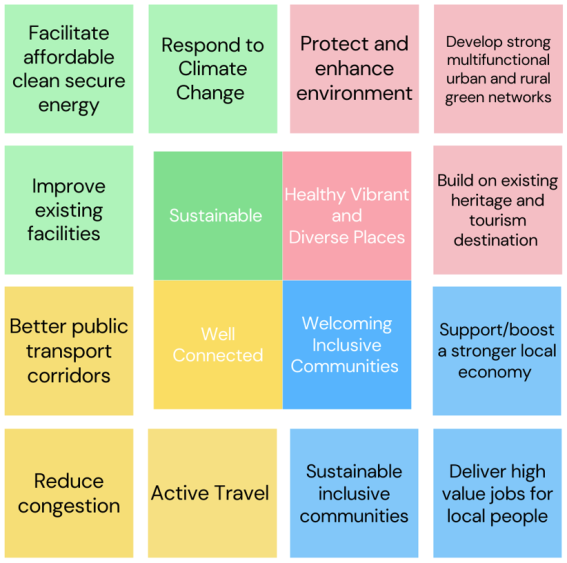
Themes and Objectives
Healthy, vibrant and diverse places
- Protect, maintain and enhance the distinct character, heritage identity and setting of Colchester city.
- Protect stretches of undeveloped countryside, enhance the quality of natural environment creating net gains to biodiversity.
- Encourage the redevelopment of brownfield land.
- Support Colchester's tourism role through the provision of additional high-quality facilities.
Sustainable
- Improve existing facilities, sustainable infrastructure, green water, wastewater, roads and schools.
- Access to high quality healthcare that is deliverable and where needed.
- Facilitate affordable clean secure energy through the delivery of sustainable energy to achieve radical reductions in greenhouse gas emissions.
- Ensure development helps Colchester to adapt and increase its resilience to the effects of climate change.
- Support the reduction of waste in line with the waste management hierarchy.
Welcoming inclusive communities
- Deliver high value jobs for local people and support a stronger local economy
- Focus on art culture, heritage and tourism.
- Deliver high quality public realm and enhance infrastructure to attract inward investment.
- Varied mix of housing to meet the needs of all, including social and lower income households.
Well-connected
- Better public transport corridors to reduce congestion and increase active travel making cycling and walking more attractive.
- Create communities which reduce the need to travel, particularly by car for most of their daily needs
