
Colchester City Council Preferred Options Local Plan Regulation 18 Consultation 2025
3. Strategic Policies
3.1 In accordance with the NPPF paragraph 20, this plan includes Strategic Policies which set out an overall strategy for the pattern, scale and design quality of places and make sufficient provision for:
- homes (including affordable housing), employment, retail, leisure and other commercial development;
- infrastructure for transport, telecommunications, security, waste management, water supply, wastewater, flood risk and coastal change management, and the provision of minerals and energy (including heat);
- community facilities (such as health, education and cultural infrastructure); and
- conservation and enhancement of the natural, built and historic environment, including landscapes and green infrastructure, and planning measures to address climate change mitigation and adaptation.
3.2 Strategic Policies provide an overview that applies across the whole area, responding to the requirements of the NPPF and supported by more detailed topic and location specific policies. In addition, neighbourhood plans must be in general conformity with the strategic policies contained in any development plan that covers their area. For the purposes of neighbourhood planning these are the strategic policies which will apply as required by the NPPF. The relevant place policies will also apply to any neighbourhood plan prepared.
Policy ST1: Health and Wellbeing View representations
The way places are planned, designed and built can have a significant influence over health and wellbeing.
All development should be designed to provide opportunities for healthy lifestyles and contribute to the creation of healthier and inclusive communities and help to reduce health inequalities for people of all ages and abilities through placemaking.
The Council will continue to work with partners and health providers to improve and promote healthier and active lifestyles for our residents and communities.
Health and wellbeing outcomes are embedded throughout the policies in the Plan. To achieve healthy and inclusive communities, all new development should:
- Promote healthy neighbourhood design, providing opportunities for healthy lifestyles for all by creating well-designed, safe and accessible places.
- Provide healthy and affordable homes that meet the needs of the community.
- Provide easy access to natural environments including green and blue infrastructure and open spaces.
- Promote active and sustainable environments and encourage active travel.
- Promote a healthy food environment.
- Provide access for all to health facilities and services, a range of employment opportunities, and sport and recreation facilities.
- Seek environmental improvements, minimising exposure to potential sources of environmental harm including pollutants and noise and improving air quality.
- Minimise, manage and mitigate against the effects of climate change.
In addition, and where appropriate, new development should support the provision of healthcare infrastructure to accommodate needs, in accessible locations, in line with the requirements outlined in the Infrastructure Delivery Plan and set out in site allocation policies.
A Health Impact Assessment will be required for all residential development in excess of 50 units or non-residential development in excess of 1,000sqm and hot food takeaways and fast food outlets in accordance with Policy PC1, in order to demonstrate that the development would have an acceptable impact on health and wellbeing. The Council will require Health Impact Assessments to be prepared having regard to the most up to date advice and best practice for such assessments. The purpose of the Health Impact Assessment will be to identify the potential health consequences of a proposal.
The assessment should include recommendations on how positive health benefits can be maximised and how negative impacts on health and inequalities can be avoided or mitigated. Where a development has a significant adverse impact on health and wellbeing, the Council will require applicants to provide for the mitigation of such impacts. Developments which will have an unacceptable significant adverse impact on health and wellbeing which cannot be mitigated, or that fail to offer reasonable provisions, will not be permitted.
Justification
Purpose of the policy
3.3 The purpose of this strategic policy is to ensure that all proposals support the health and wellbeing of all our communities. In line with the NPPF, the policy aims to achieve healthy, inclusive and safe places, enabling and supporting healthy lives and reducing health inequalities.
3.4 The policy acknowledges the interconnection between health and wellbeing and the climate, the environment, and place-making and design. Healthy lifestyles can be supported and improved through high quality inclusive design and planning, providing healthy homes, increasing inclusivity and providing access to local services; encouraging access to natural environments and encouraging active travel to enable communities to be physically active; and promoting access to healthy food.
3.5 To ensure healthy and wellbeing is supported, promoted and improved through new development, and any impacts on health are identified, a Health Impact Assessment will be required in line with current best practice advice.
Alternative
3.6 The alternative is to not include a policy on this subject matter and rely on the NPPF. However, national policy does not provide any local context or address the interconnection with other relevant policies in this Local Plan.
Policy ST2: Environment and the Green Network and Waterways View representations
All proposals must conserve and enhance Colchester's natural and historic environment, including the protection and enhancement of sites of international, national, regional, and local importance. The Council will safeguard the landscape character of Colchester as defined by the area's existing biodiversity, geology, green network and waterways, history, and archaeology. The Council will support the use of Natural England's Environmental Benefits from Nature tool.
Proposals must have regard to delivering the aims and objectives of the Essex Local Nature Recovery Strategy and Essex Coast Recreational disturbance Avoidance and Mitigation Strategy (RAMS) or any relevant successor documents. Proposals for habitat creation, enhancement and BNG should have regard to the Colchester City Strategic Biodiversity Assessment.
Strategic areas that present the best opportunities for habitat creation and enhancement aimed at improving biodiversity are shown on the policies maps as 'strategic biodiversity areas'. These strategic biodiversity areas will be protected, and support will be given to strengthening and enhancing connections between habitats to improve their contribution to the biodiversity network.
All major residential development proposals must have a Green Network and Waterways Plan (which could form part of the Design and Access Statement) setting out how the development meets the Council's Green Network and Waterways Guiding Principles. The Plan should include details of the timescale for the implementation of each aspect of the Plan within that phase of development and details of the quality standard of construction and maintenance.
Open spaces should be incorporated into other strategies and plans for the site, such as surface water management strategies, landscape, utilities, and biodiversity net gain to coordinate delivery, management and maintenance.
Justification
Purpose of the policy
3.7 The purpose of this strategic policy is to ensure that all proposals conserve and enhance the natural and historic environment and that major residential proposals deliver contextually responsive, high quality open spaces. The key purpose of this strategic policy and indeed all policies in the Environment chapter, is to respond to the creating a better environment agenda by halting overall biodiversity loss, supporting healthy well-functioning ecosystems, and supporting and establishing coherent ecological networks, with more and better places for nature for the benefit of wildlife and people.
3.8 Planning reforms, the Environment Act, and the Environmental Improvement Plan, provide significant opportunities for planning to play a key role in creating a better environment for future generations. Responding to the increasing environmental agenda in plan making requires a coherent and streamlined approach which complements the complex environmental agenda requiring integrated, coordinated approaches to achieve multifunctional benefits from the use of land.
3.9 Nature in Essex has suffered significantly over the last century, and continues to suffer, from species loss, habitat loss and increased habitat erosion and fragmentation. There are multiple causes to this loss and increased isolation of habitats across the landscape, including land use change, invasive species, pollution, overexploitation and climate change. It is crucial that nature recovery is at the centre of future action for the environment, to create new habitats and recover and enhance space for nature that has been lost or degraded.
3.10 The Council is a 'Supporting Authority' in the Essex Local Nature Recovery Strategy (LNRS). The role of LNRS' is to provide a county-wide, practical solution to driving action for nature recovery on the ground. The primary purpose of the Essex LNRS is to identify locations to create or improve habitat most likely to provide the greatest benefit for nature and the wider environment. The Council has had regard to the Essex LNRS throughout plan preparation.
3.11 The presence of clusters of designated sites and, in some cases, older landscapes that aren't designated but that have the potential to make a significant contribution to biodiversity, has been used to identify areas of significance for the conservation of biodiversity. These strategic biodiversity areas present the best opportunities for habitat creation and enhancement aimed at improving biodiversity. Each of the strategic biodiversity areas has an inherent degree of coherence and connectivity.
3.12 Enhancing ecological connections as a priority is aimed at improving the robustness of species populations by increasing gene flow between nearby populations, allowing colonisation of new sites, and facilitating re-colonisation of sites where populations may be lost by adverse impacts. With climate change impacting on environmental conditions in a profound way, these connections also offer a chance for species to find somewhere better suited to their needs if necessary.
3.13 Such connections also serve to improve the general ecological condition of the wider landscape, serving as a reservoir of biodiversity that can then permeate the whole landscape, including those areas of residential development to which they are connected.
3.14 Protecting, strengthening and enhancing habitats and corridors within the strategic biodiversity areas can be achieved through broadening connections and improving the condition of the habitats, as well as creating more links with nearby LoWS through the design of green infrastructure and mitigation habitats within development sites as well as through compensation measures and biodiversity net gain in the wider landscape.
3.15 The Local Plan evidence base includes evidence that is relevant to this strategic policy and the environment and sustainability policies that follow, such as the Habitats Regulations Assessment, Biodiversity Protection and BNG Study, Landscape Character Assessment, and Colchester's Green Network and Waterways Guiding Principles.
Alternative
3.16 This alternative is to not require a green network and waterways plan and for proposals to follow the business-as-usual approach with a consequential continuity of outcomes for ecology. However, this would fail to address the planning for a better environment agenda.
The Spatial Strategy
3.17 The spatial strategy sets out the place-based approach for how growth will be guided across Colchester to 2041. This provides the framework for how the housing and employment needs will be met through allocations in the Local Plan, taking into account the unique characteristics of areas across the City.
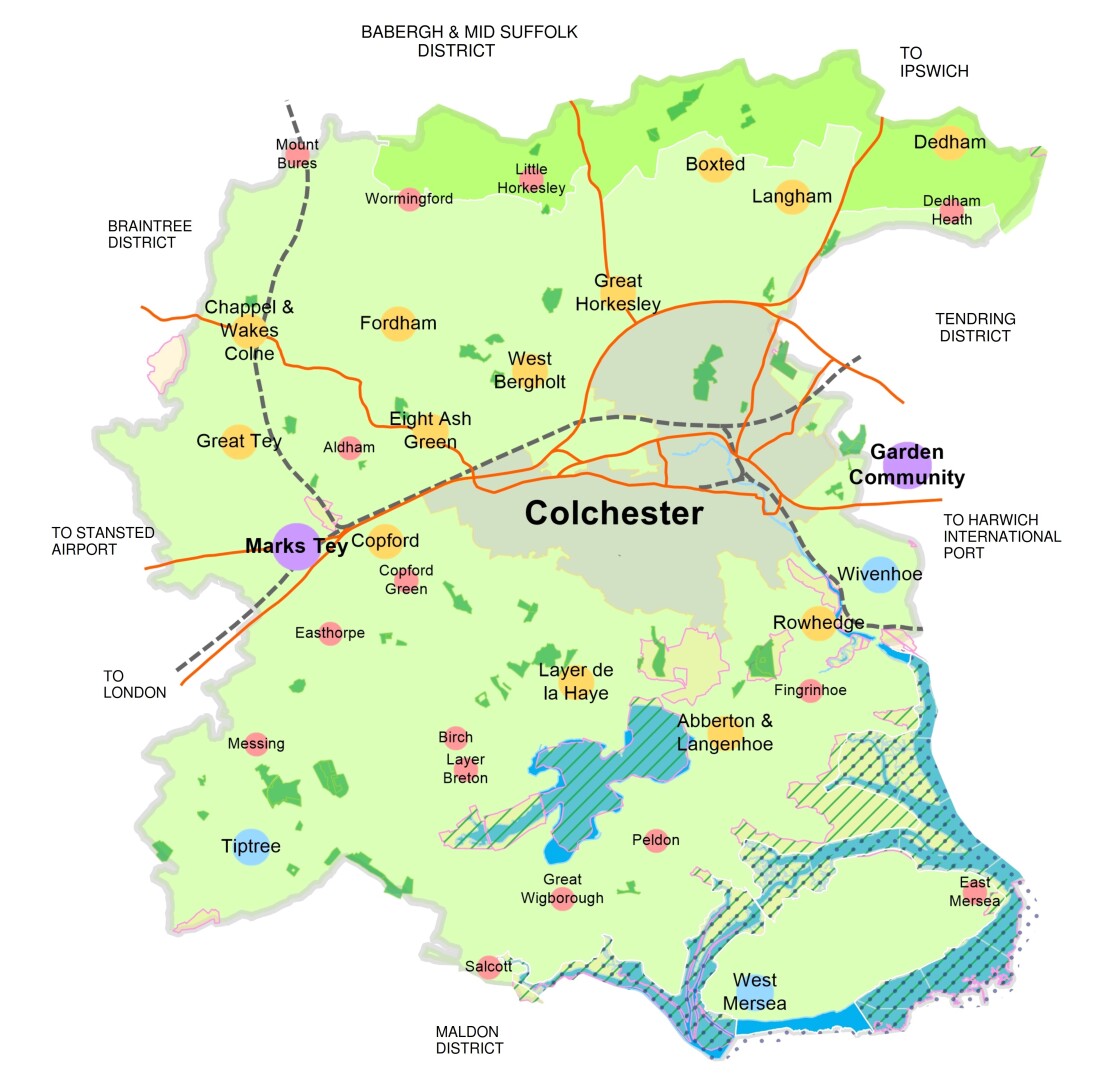
3.18 The settlement hierarchy forms part of the spatial strategy. Growth will be allocated in accordance with the spatial strategy and settlement hierarchy. This recognises the relationship between the Urban Area of Colchester, growth and opportunity areas within and outside of the urban area (Marks Tey and TCBGC) and the larger settlements of, Tiptree, West Mersea and Wivenhoe. This also recognises the role that other settlements play in creating diverse places across Colchester, as well as the importance of the countryside that should be protected
3.19 In the first instance, development is directed to the City centre and the urban area of Colchester. This will enable greater use of brownfield sites to be realised and developments of a higher density. This approach is reflected in the NPPF.
3.20 The next tier in the settlement hierarchy is growth and opportunity areas. A number of sites are allocated for residential, employment / mixed use development within the urban area of the City. The Hythe which has seen significant changes over the years, notably through recently approved and built student accommodation is identified as an opportunity area where there are opportunities here for wider regeneration. This area is an established regeneration area that seeks to deliver sustainable, mixed-use neighbourhoods, identifying the River Colne as a feature and respecting the historic character of the area. Magdalen Street where regeneration could help deliver a new and improved gateway to the City Centre is also identified as an opportunity. There are a number of older commercial buildings suitable for reuse and or redevelopment to enhance this area. This tier in the hierarchy also includes the University of Essex, Knowledge Gateway and north Colchester.
3.21 Marks Tey is also identified in this tier as a growth area, recognising its potential opportunities for strategic scale growth and potential for improvements to infrastructure and placemaking. Its strategic location along with the benefits the train station brings, support the potential for expansion. However, there is also recognition that infrastructure improvements will be required in order to support development at the scale promoted. Tendring Colchester Borders Garden Community (TCBGC) is established and defined in a separate Development Planning Document. It continues to form an integral part of how this area of North Essex will develop up to 2041 and beyond. In recognition of the contribution it will make to towards the supply in this plan period for Colchester it is defined as a growth area in the hierarchy.
3.22 Key transport corridors across Colchester have also been identified for their function and connectivity and potential to support growth. The role of larger settlements outside of the urban area is also recognised. These larger settlements have the most facilities, services and opportunities. These settlements also have some of the largest populations of Colchester. As such, it is proposed to group, Tiptree, Wivenhoe and West Mersea as the next tier within the hierarchy as large settlements. Growth in these settlements not only reflects their size but also considers the opportunities and constraints that apply to each location.
3.23 Creating a distinction between the large, medium and small settlements enables small scale development, which has been identified as a desire in some of the small settlements through engagement undertaken as part of the Issues and Options. The settlement hierarchy identifies medium and small settlements where growth is allocated appropriate to the size of the settlement and its constraints. Growth is not directed to all of the smaller settlements as appropriate land for growth was not identified for every small settlement.
3.24 The spatial strategy also reflects sustainable development principles underpinned by the NPPF which seeks to ensure all development meets the three dimensions of sustainable development; social, economic and environmental sustainability. All development will need to be in accordance with the spatial strategy and should meet the three dimensions of sustainable development.
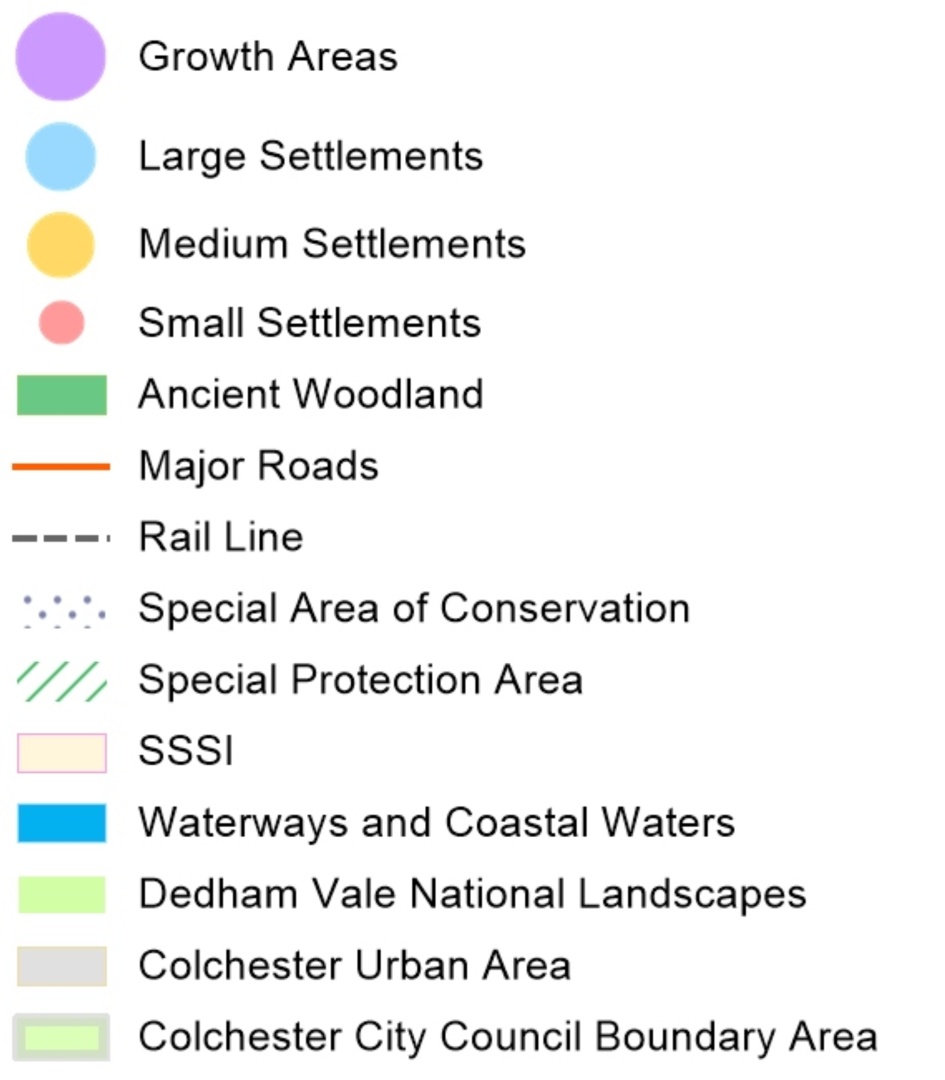
3.25 The key diagram illustrates the spatial strategy for this Plan.
Policy ST3: Spatial Strategy View representations
The Plan makes provision for growth and supporting infrastructure across the Colchester area to 2041. A sufficient number of homes have been provided in the plan to meet the overall housing requirement to 2041 as set out in Policy ST5.
Growth is directed across Colchester starting with the most sustainable and accessible locations in the urban area or close to, transport corridors and existing centres, where there tends to be a range of employment opportunities, facilities, services and travel choices for future communities.
Additionally, an appropriate level of growth is allocated within the large, medium and some small settlements, based on the opportunities and constraints of each settlement and informed by the wider evidence base. This can help support the long-term viability of services and facilities, which may otherwise be lost.
The growth needs of Colchester are balanced against the need to protect and enhance biodiversity, landscape and heritage. The highest areas of sensitivity are receiving the lowest levels of growth in this Local Plan. This approach also ensures that existing settlements maintain their distinctive character and role by avoiding harmful coalescence between them and through conserving their setting. New development will be required to respect the character and appearance of landscapes and the built environment and preserve or enhance the historic environment and biodiversity to safeguard the character of the City.
The Tendring Colchester Borders Garden Community (TCBGC) and other large-scale developments will deliver substantial growth, enabling significant community benefits to be realised. Opportunities for growth along key transport corridors, particularly with access to the rail network are favoured subject to sufficient capacity on the network and/or appropriate mitigation to support any enhancement required.
The re-use of previously developed land and developments of higher densities (particularly in the Urban Area of Colchester) will be supported where this enables a more efficient use of land. Opportunity areas are therefore identified at the Hythe and Magdalen Street.
The primary focus for growth is made through the allocations identified in this Local Plan, together with the existing commitments and TCBGC as set out in Policy ST5. Allocations are made in accordance with the settlement hierarchy set out below. The settlement hierarchy groups areas across Colchester based on their sustainability merits, size, function, opportunities and the services provided in each locality.
Settlement Hierarchy
Colchester Urban Area including City Centre
Growth and Opportunity Areas
Hythe Opportunity Areas
Magdalen Street Opportunity Area
Marks Tey Growth Area
Tendring Colchester Borders Garden Community Growth Area
Large Settlements
Tiptree
West Mersea
Wivenhoe
Medium Settlements
Abberton and Langenhoe
Boxted
Chappel and Wakes Colne
Copford
Dedham and Dedham Heath
Eight Ash Green
Fordham
Great Horkesley
Great Tey
Langham
Layer de la Haye
Rowhedge
West Bergholt
Small Settlements
Aldham
Birch and Layer Breton
Copford Green
Easthorpe
East Mersea
Fingringhoe
Great Wigborough
Little Horkesley
Messing
Mount Bures
Peldon
Salcott
Wormingford
Countryside
KEY DIAGRAM
Justification
Purpose of the policy
3.26 The NPPF requires Strategic Policies in Local Plans to set out an overall strategy for the pattern, scale and design quality of places. Strategic Policies are required to provide a clear strategy for bringing sufficient land forward to address needs over the plan period, in line with the presumption for sustainable development. The Strategy must provide for social and economic needs, sufficient strategic and local infrastructure, whilst balancing the conservation and enhancement of the natural, built and historic environment, and address climate change, mitigation and adaptation.
3.27 The Spatial Strategy sets out the approach for how Colchester will develop to 2041. This informs where sites will be allocated for housing and economic growth, and where areas will be safeguarded and protected in this Preferred Options Local Plan.
Alternative
3.28 The alternative spatial options considered were:
- Continuing existing Spatial Strategy
- New Garden Community
- Garden Suburbs
- Intensification in the City Centre
- Transport Corridors
- Hubs and Spokes
- Environment Led
3.29 The preferred spatial strategy draws together the positives from as many of the spatial options as possible, while ensuring the growth needs of Colchester are met. These include:
- Focus on the existing urban area and intensification where appropriate largely within growth and opportunity areas;
- Significant scale of growth along transport corridors;
- Growth in the other settlements, including some of Colchester's smaller villages, to support communities and provide opportunities to sustain and enhance facilities and infrastructure;
- Ensure protection and enhancement of the most sensitive environments
Policy ST4: Development in the Countryside View representations
The Council will consider the requirement for new development within the countryside to meet identified development needs in accordance with Colchester's spatial strategy while supporting the vitality of rural communities. This will be balanced against ensuring development does not have an adverse impact on the different roles and relationships between settlements and their separate identities, valued landscapes, the intrinsic character and beauty of the countryside and visual amenity.
The intrinsic character and beauty of the countryside will be recognised and assessed, and development will only be permitted where it would not adversely affect the intrinsic character and beauty of the countryside.
Proposals must consider the role the landscape plays as an open buffer between settlements or areas of a settlement, and the resulting sense of separation and distinctive identity.
Within valued landscapes, development will only be permitted where it would not impact adversely and would protect and enhance the factors that contribute to valued landscapes.
Proposals for sustainable rural businesses will be supported if they are of an appropriate scale, meet a local employment need, minimise negative environmental impacts, and harmonise with the local character and surrounding countryside where they are being proposed.
Where residential proposals are located outside defined settlement boundaries, there should be consideration of the physical and functional connection to the defined settlement in the first instance. Residential proposals in the countryside should conserve and enhance the character, quality and tranquillity of the landscape, and it must be proven that they will protect and reinforce the rural character of the areas where a development is proposed. Proposals will need to demonstrate that the scheme respects the character and appearance of landscapes and the built environment and preserves or enhances the historic environment and biodiversity. Opportunities to maximise access to sustainable modes of travel for future residents must be demonstrated.
Justification
Purpose of the policy
3.30 The purpose of the planning system is to contribute to the achievement of sustainable development. The NPPF recognises that there are three dimensions to sustainable development: economic, social and environmental. Settlement boundaries are an essential tool for the management of development and contribute to the achievement of sustainable development by preventing the encroachment of development into the countryside, protecting rural character. The spatial strategy (Policy ST3)directs development to the most sustainable locations across Colchester.
3.31 Areas outside of settlement boundaries are defined as 'Countryside'. Within the countryside, there are a number of very small villages and hamlets and isolated clusters of dwellings which lack any community facilities or access to services or public transport and rely on nearby larger settlements to meet their daily needs. It is essential that development is restricted in the countryside to protect landscape, character, quality and tranquillity.
3.32 Development within the countryside will accordingly be limited to activities that either require a rural location or help sustain a rural community and local economy and which help protect the rural character of the areas where a development is being delivered.
3.33 The NPPF includes examples of exceptions whereby proposals for isolated dwellings in the countryside may be acceptable. The Council's interpretation of 'isolated' are sites that are physically isolated relative to existing settlements, and sites that are functionally isolated relative to services and facilities.
Alternative
3.34 The alternative is to rely on national policy and guidance or the spatial strategy and housing allocations policies.
Provision for Homes and Jobs
3.35 Paragraph 61 of the NPPF states that a key objective of the Government is to boost the supply of homes. It stresses the importance of providing a sufficient amount and variety of land which can come forward where it is needed. In accordance with Paragraph 62 of the NPPF the Council commissioned a Local Housing Needs Assessment which used the standard method as set out in national planning practice guidance (December 2024), to consider the overall need for housing in Colchester. This identifies the need for different types of homes, and needs of different groups within the local community. The Council has engaged with Tendring District throughout the plan making process as it shares a housing market area.
3.36 The Local Housing Needs Assessment September 2024 confirms that using the Standard Methodology for calculating housing need, there is a need for1300 new homes per year. This equates to 20,800new homes over the plan period to 2041. In accordance with the NPPF December 2024, this is a mandatory target which must be planned for.
3.37 In the last financial year (April 2023 to March 2024) 1,098 new homes were delivered in Colchester. There are also a number of sites that have already been granted planning permission or are committed and supported by with evidence to support their early delivery. These are forecast to deliver 6,117 new homes in the plan period as outlined in Policy ST5.
3.38 The Tendring Colchester Borders Garden Community will deliver circa 7,500 new homes in the longer term. A total of 3,400 new homes will be delivered up to 2041, with the number of new homes to be divided equally between Tendring and Colchester. As a result, 1,700 new homes from the Garden Community will make a contribution to the housing needs of Colchester within the plan period.
3.39 Based on past delivery records, windfall sites will also make an important contribution to Colchester's housing need. Windfall sites are defined as sites that are not allocated in the Local Plan. Assessing past contributions from windfall sites in Colchester, has demonstrated that an average of 238 homes per annum have been delivered on windfall sites (from 2014/15 to 2023/24). As a result, a windfall allowance of 200 new homes a year for the later 11 years of the plan period is considered a robust and justified contribution to the overall housing supply. 2,200 homes are anticipated to be delivered through windfall sites by 2041
3.40 Taking all the above into account, during the remainder of the plan period, the Council need to plan for a minimum of 11,089 new homes in order to meet the housing needs for Colchester.
3.41 Colchester has an excellent track record of housing delivery. Since 2001/02 it has overseen the delivery of over 21,000 new homes at an average rate of 940 new homes per year. Over the previous plan period to date (2017 – 2024) the Council exceeded its cumulative housing target by almost 500 dwellings. Therefore, at the beginning of the new plan period the Council is not in a position where it needs to make up any previous shortfall in housing delivery.
3.42 The methodology for planning for employment growth is less rigid than that for housing, although the NPPF requires plans to identify a future supply of land which is suitable, available and achievable for economic development uses over the Local Plan period
3.43 The Employment Land needs assessment has considered the approach, existing supply and demand to arrive at a need of 41.7 hectares of employment land up to 2041. This is based on the preferred scenario (Labour Supply) which is based on population projections, linked to housing growth projections, it represents an approach which seeks to maximise the opportunities for the economically active population in the Local Authority Area. This represents the most optimistic scenario for employment growth to align with wider corporate objectives for economic growth.
3.44 The Employment Study identifies key sectors likely to influence demand for employment space over the plan period including the digital, creative and tech and financial and business service sectors, and key sectors likely to influence demand for industrial space include advanced manufacturing, construction, transport and logistics and green energy. Proposals which support these sectors will particularly be encouraged in line with the requirements of the Policy and are set out in the relevant Place Policy.
Policy ST5: Colchester's Housing Need View representations
The Council will plan, monitor and manage the delivery of at least 20,800 new homes in Colchester City between 2025 and 2041.
The annual housing requirement for Colchester is 1,300, as identified by the Standard Methodology.
Table ST5.1: Housing Supply
|
Housing Supply as at 31st December 2024 |
Net New Homes |
|
Existing Commitments (sites with planning permission) |
6,117 |
|
Tendring Colchester Borders Garden Community |
1,700 |
|
Windfall Allowance |
2,200 |
|
Local Plan Allocations |
11,089 |
|
TOTAL SUPPLY |
21,106 |
The Council will maintain a sufficient supply of deliverable and developable sites to provide for at least five years' worth of housing on a rolling basis, plus an appropriate buffer in accordance with national policy.
The overall distribution of new housing across Colchester is guided by Spatial Strategy (Policy ST3).
TABLE ST5.2 Local Plan Housing Allocations
|
Location |
Number of New Homes |
Policy Reference |
|
Britannia Car Park |
100 |
PP1 |
|
Vineyard Gate |
100 |
PP2 |
|
Runwald St Car Park |
40 |
PP3 |
|
Braiswick |
30 |
PP4 |
|
Land at Chesterwell |
50 |
PP5 |
|
Land at Colchester Station |
250 |
PP6 |
|
Land off Bakers Lane |
100 |
PP7 |
|
Land off Lakelands Crescent |
5 |
PP8 |
|
Northeast Colchester |
2,000 |
PP9 |
|
Land South of Berechurch Hall Road |
875 |
PP10 |
|
Europit Site |
40 |
PP11 |
|
Land at Roberston Van Hire Site |
6 |
PP12 |
|
146 Magdalen Street Site |
15 |
PP13 |
|
Gas Works and Hythe Scrap Yard Site |
200 |
PP14 |
|
Hawkins Road |
50 |
PP15 |
|
Coal Yard site |
50 |
PP16 |
|
King Edward Quay Opportunity Area |
200 |
OA1 |
|
Land East of Hawkins Road Opportunity Area |
150 |
OA2 |
|
Magdalen Street Opportunity Area |
100 |
OA3 |
|
Land south of A12 & Marks Tey Village |
1,500 |
PP17 |
|
Land North of A120, Marks Tey |
1,000 |
PP18 |
|
Land North of Oak Road, Tiptree |
600 |
PP19 |
|
Land at Bonnie Blue Oak, Tiptree |
30 |
PP20 |
|
Highlands, Kelvedon Road, Tiptree |
10 |
PP21 |
|
Former Telephone Exchange, Station Road, Tiptree |
5 |
PP22 |
|
Land East of Dawes Lane, West Mersea |
300 |
PP23 |
|
Land Northwest of the Fire Station, Wivenhoe |
175 |
PP24 |
|
View Park, Abberton and Langenhoe |
50 |
PP25 |
|
Land North of Boxted Straight Road |
150 |
PP26 |
|
Swan Grove, Chappel |
35 |
PP27 |
|
Land West of Station Road, Wakes Colne |
200 |
PP28 |
|
Land East of School Road, Copford |
300 |
PP29 |
|
Land South of Long Road, Dedham |
15 |
PP30 |
|
Land North of Halstead Road East of Wood Lane, Eight Ash Green |
180 |
PP31 |
|
Land North of Halstead Road West of Fiddlers Wood, Eight Ash Green |
250 |
PP32 |
|
Land East of Plummers, Fordham |
25 |
PP33 |
|
Land North of Coach Road, Great Horkesley |
400 |
PP34 |
|
The Old School, Great Horkesley |
13 |
PP35 |
|
Land at Earls Colne Road, Great Tey |
125 |
PP36 |
|
Land North of Park Lane, Langham |
900 |
PP37 |
|
Land opposite Wick Road, Langham |
10 |
PP38 |
|
Land at The Furze, Layer de la Haye |
10 |
PP39 |
|
Land West of The Folley, Layer de la Haye |
60 |
PP40 |
|
Rowhedge Business Park, Rowhedge |
50 |
PP41 |
|
Land at White Hart Lane, West Bergholt |
50 |
PP42 |
|
Land North of Colchester Road, West Bergholt |
100 |
PP43 |
|
Land off Colchester Road, West Bergholt |
100 |
PP44 |
|
Land off New Road, Aldham |
15 |
PP45 |
|
Land at Birch Green, Birch |
15 |
PP46 |
|
Land at Picketts Farm, Fingringhoe |
5 |
PP47 |
|
Kelvedon Road, Messing |
25 |
PP48 |
|
Land at St Ives Road, Peldon |
25 |
PP49 |
|
TOTAL |
11,089 |
Justification
Purpose of the policy
3.45 To plan for Colchester's housing need, the Council needs to ensure enough land is allocated for residential uses to accommodate the predicted level of housing growth over the plan period. The land required to accommodate this housing growth is known as the housing land supply. The NPPF requires policies to identify sufficient sites to deliver the required housing supply over the plan period. The housing land supply comprises existing commitments and new allocations.
3.46 Through the previous Local Plan, the principle of development of a Garden Community on the Tendring and Colchester border was established. Colchester City Council, Tendring District Council and Essex County Council have worked together to prepare a Development Plan Document which provides a framework to guide the development of the Garden Community. Circa 7,500 new homes will be delivered at the Garden Community, with delivery through the plan period contributing to Colchester's supply.
3.47 Existing commitments are residential sites with planning permission or where the granting of planning permission is considered to be imminent. Many of these sites, were allocated for residential use in the current Adopted Local Plan. Existing commitments also includes allocations from made Neighbourhood Plans
3.48 Due to historic trends of windfall within the City, the Council will be applying a windfall allowance in line with paragraph 71 of the NPPF. The Council's criteria for a site to be considered windfall is that it should not form part of a current allocation. There is no one approach to a windfall allowance methodology, but it is reasonable to consider past windfall rates as a basis for the expectation of the levels of windfall that will come forward in the future. This approach is widely used and can aid in considering the likely windfall that will come forward in the future.
3.49 Allocations are sites which are proposed for residential uses as part of the preparation of this Draft Local Plan. Colchester has a very good track record of regenerating previously developed land within its urban area and as a result the City has a limited and diminishing supply of brownfield sites that can contribute to accommodating new growth. Accordingly, allocations within this Draft Local Plan include a high level of new greenfield sites. These sites have been subject to thorough assessment to determine their sustainability and suitability for residential uses. The same assessment has been undertaken for allocations in the current Adopted Local Plan which have not yet been implemented. All proposed allocations have also been subject to discussions with stakeholders to ensure sites have been selected based on their availability, achievability and deliverability. It will be important as the plan progresses to ensure all allocations are developable, viable, suitable and available and can deliver policy compliant schemes.
3.50 The Place Policies in this Draft Local Plan provide detail on specific new allocations along with further information on infrastructure improvements and mitigation measures required to address site constraints and opportunities at each location. Allocations will provide approximately 11089 new homes. All allocations are set out in their respective Place Policies.
3.51 Table ST5.2 lists the settlements where the allocations are proposed and where that settlement boundary will be extended in relation to the site allocation. It is acknowledged that the following allocations are in part or wholly situated on land which falls within an adjoining Parish
- PP17 Land South of A12, Marks Tey Growth Area – includes land within Marks Tey, Aldham Parish, and Great Tey Parish.
- PP18 Land North of A120, Marks Tey Growth Area – includes land within Marks Tey Parish, and Copford with Easthorpe Parish.
- PP19 Land North of Oak Road, Tiptree – includes land within Tiptree Parish and Messing cum Inworth Parish.
- PP32 Land North of Halstead Road Eight Ash Green and West of Fiddlers Wood Eight Ash Green – land is located within Aldham Parish.
3.52 Ensuring the quality of new housing development is of equal importance to ensuring its quantity. The Council will actively work with landowners, planning agents and housebuilders to bring forward those allocated sites that accord with the overall spatial strategy and relevant policies in the Plan.
Alternative
An alternative to this policy approach is the provision of a more dispersed pattern of new development.This option would spread the impact of new development more widely across Colchester but would be unlikely to secure key infrastructure, which is required to support sustainable growth and could therefore be expected to result in higher overall levels of growth in villages and within existing communities, highway congestion and restricted infrastructure. The distribution reflects the spatial strategy which considered a number of alternatives.
Policy ST6: Colchester's Employment Needs View representations
The Council will plan, monitor and manage the delivery of at least 41.7ha of employment land in Colchester City to meet the projected demand up to 2041. Employment uses will be provided on a range of sites to ensure jobs are accessible to new and existing communities across Colchester.
Table ST6.1: Local Plan Employment Provision
|
Location |
Employment Land (approx. ha) |
Policy Reference |
|
Land north of Axial Way, Northern Gateway, North Colchester |
2.3ha |
OA4 |
|
Colchester Business Park |
2.4ha |
PEP1 |
|
Knowledge Gateway |
4.5ha |
PEP2 |
|
Land South of Tollgate West |
3.7ha |
PEP3 |
|
Maldon Road |
0.7ha |
PEP4 |
|
Land south of A12 Marks Tey |
16ha |
PEP5 |
|
Anderson's Site, Marks Tey |
3.2ha |
PEP6 |
|
Highlands Nursery, Tiptree |
1.1ha |
PEP7 |
|
Land South of Factory Hill, Tiptree |
4.7ha |
PEP8 |
|
Bullbanks Farm, Eight Ash Green |
0.8ha |
PEP9 |
|
Lodge Lane, Langham |
1ha |
PEP10 |
|
Land at Pattens Yard, West Bergholt |
2.1ha |
PEP11 |
|
Land at Wakes Hall Business Centre |
0.9ha |
PEP12 |
|
Tendring Colchester Borders Garden Community |
3.5ha |
ST9 |
|
TOTAL |
46.9ha |
Proposals for new employment uses within the existing and defined employment areas will be supported. Employment uses for the purposes of this policy are defined as Use Classes E(g), B2, and B8. Alternative economic class uses may contribute to the provision of jobs providing flexibility and securing delivery of additional jobs. Suitable alternative economic uses will be supported within existing and defined areas where they are in accordance with all relevant policies in the plan, including impact assessments where these alternative uses are for town centre uses and the threshold applies.
Justification
Purpose of the policy
3.53 The NPPF states that planning decisions should help create the conditions in which businesses can invest, expand and adapt. They should support economic growth and productivity, taking into account both local business needs and wider opportunities for development. Decisions should also allow an area to build on its strengths, counter any weaknesses, and address any challenges in the future. Planning policies should set out a clear economic vision and strategy which positively and proactively encourages sustainable economic growth. The NPPF states that Councils should identify a future supply of land which is suitable, available and achievable for economic development uses over the Local Plan period.
3.54 To plan for Colchester's employment needs, the Council needs to ensure that enough land is allocated, and sufficient policy approaches adopted to deliver sustainable economic growth across Colchester. The Colchester Employment Land Needs Assessment (2024) provides an assessment of the balance of supply and demand in the context of changing employment needs, trends and challenges. The Employment Study demand assessment estimates that there is a net additional demand for 41.7ha of employment land across Colchester over the plan period.
3.55 The purpose of the policy is to ensure that land is allocated and safeguarded for employment purposes that meet the needs of Use Classes E(g), B2 and B8 as defined by the Use Classes Order 1987 (as amended), in sustainable locations and in line with recommendations set out in the Colchester Employment Land Needs Assessment. The policy identifies land that, in addition to existing approved permissions within the planning pipeline, will meet the projected demand for additional good quality, well-located employment sites. Some of these sites are employment allocations that have been carried forward from the adopted Local Plan or allocations contained in adopted Neighbourhood Plans.
3.56 The Place Employment Policies in this Draft Local Plan provide detail on specific new allocations along with further information on infrastructure improvements and mitigation measures required to address site constraints and opportunities at each location. An Employment and Skills Plan will be required in line with ECC guidance. This must be prepared collaboratively with the Council and relevant stakeholders.
3.57 In addition to land allocated for employment uses as set out in Table ST6.1, employment uses will also be delivered through opportunity areas and mixed use and larger residential allocations as set out in the relevant Place Policy.
3.58 Existing fit for purpose employment sites are protected for employment uses through other policies in the plan including Policy E1.
3.59 Further detail on employment provision in the Colchester Tendring Borders Garden Community can be found in Policy ST9.
Alternative
3.60 The alternative is to not allocate employment land in the plan or allocate other sites for employment uses. However, the NPPF requires Councils to identify a future supply of land for employment uses over the Local Plan period and this is therefore not considered a reasonable alternative. The sites identified have been assessed and represent land which is suitable, available and achievable for economic uses and which will contribute to employment supply.
Policy ST7: Infrastructure Delivery and Impact Mitigation View representations
All development must be supported by the provision of infrastructure, services and facilities that are identified as being needed to serve the needs arising from the development. Permission will only be granted if it can be demonstrated that there is sufficient and appropriate infrastructure capacity to support the development or that such capacity will be delivered by the proposal. It must further be demonstrated that all necessary infrastructure will be delivered at an appropriate time to meet the requirements of the development, and that such capacity will prove sustainable over time in physical and financial terms.
Where a development proposal requires additional infrastructure capacity to be deemed acceptable, mitigation measures must be agreed with the Council and the appropriate infrastructure provider. Such measures may include:
- Financial contributions towards new or expanded facilities and the maintenance thereof;
- on-site provision of new facilities (which may include building works);
- off-site capacity improvement works; and/or
- the provision of land.
Developers will be expected to contribute towards the delivery of relevant infrastructure as required and supported by up-to-date evidence from appropriate sources including the Infrastructure Audit Delivery Plan (IADP) and any subsequent updated evidence, along with information from local sources including parish and town councils. Developers will be required to either make direct provision or to contribute towards the provision of local and strategic infrastructure required by the development, either alone or cumulatively with other development.
This policy will apply to all development proposals. Location specific infrastructure requirements are also contained within the relevant site allocation policies.
New streets should seek to be built to adoptable design standards in adherence with current guidance and standards. Where streets are not built to an adoptable standard, there must be a substantive place making benefit.
At the time of adoption, every allocation will be considered to be viable, based on information provided to the Council. Where an applicant/developer is seeking an exception to this policy later in the plan period, it will only be considered whereby:
- A fully transparent open book viability assessment has proven that full mitigation cannot be afforded, allowing only for the minimum level of developer profit and landowner receipt necessary for the development to proceed; and
- It is proven that the public benefit of the development proceeding without full mitigation outweighs the collective harm; and
- Full and thorough investigation has been undertaken to find innovative solutions to issues and all possible steps have been taken to minimise the residual level of unmitigated impacts; and
- Obligations are entered into by the developer that provide for appropriate mitigation in the event that viability improves prior to completion of the development. In such cases the Council may seek a staged review of the viability of a scheme with the aim of achieving policy compliance over time. This may include securing a review mechanism by legal agreement specifying trigger points for undertaking a review such as later phases of a scheme or reserved matters applications.
The Council will consider introducing a Community Infrastructure Levy (CIL) and will implement such for areas and/or development types where a viable charging schedule would best mitigate the impacts of growth. Section 106 will remain the appropriate mechanism for securing land and works, affordable housing and financial contributions where a sum for the necessary infrastructure is not secured via CIL.
Justification
Purpose of the policy
3.61 The sustainable delivery of new homes and jobs needs to be supported by the provision of appropriate new and upgraded infrastructure, including transport, community facilities and utilities. New development can place additional demand on existing infrastructure. Therefore, new development proposals must contribute to improvements in infrastructure to cater for the additional needs that they generate.
3.62 The NPPF requires that all plans should promote a sustainable pattern of development that seeks to 'align growth and infrastructure'. The NPPF requires that strategic policies should set out an overall strategy for the pattern, scale and design of places and make sufficient provision for infrastructure for transport, telecommunications, security, waste management, water supply, wastewater, flood risk and coastal change management, and the provision of minerals and energy (including heat); community facilities (such as health, education and cultural infrastructure); and green infrastructure. It also requires that plans should set out the contributions expected from development, including infrastructure.
3.63 The purpose of the policy is to ensure that provision of infrastructure is aligned with growth. The policy identifies infrastructure necessary to serve new development during the Plan period. Site allocation policies in the plan will identify essential site-specific infrastructure relevant to the allocation.
3.64 An Infrastructure Delivery Plan (IDP) is being prepared to inform and support the Local Plan. This has been developed with infrastructure service providers and partner organisations to determine where additional infrastructure is necessary. The IDP will sit alongside the Plan and provide specific detail on the main items of infrastructure required, when they are likely to be required, and who will provide them. The IDP will be supplemented by updated evidence over the lifetime of the plan which will inform the infrastructure to be provided in relation to individual developments.
3.65 The broad categories of necessary infrastructure included in the IDP include:
- Social Infrastructure (Education, Early Years and Childcare, Sport and Leisure, Open Spaces, Green Infrastructure, Community Facilities, Primary Healthcare, Emergency Services, Health Services)
- Transport Infrastructure (Active Travel, Public Transport, Roads, Electric Vehicle infrastructure)
- Utilities, Waste and Water (Utilities, Telecommunications, Water, Wastewater, Flood Defence, Surface Water Management, Water Resource Management)
3.66 The Council will seek contributions from developers to fund new facilities and improvements to existing infrastructure and the environment where it is necessary to mitigate the impact of new development. Local communities should be involved in the setting of policies for contributions expected from new development and it is expected that policies in the Place section of this Plan will reflect that. The Local Plan has been informed by evidence of infrastructure and affordable housing need, and a proportionate assessment of viability that considers all relevant policies, and local and national standards. Accordingly, allocations will be made based on evidence that they are viable.
3.67 Planning obligations will be made through section 106 agreements and section 278 agreements. Contributions may also be made through the Community Infrastructure Levy (if adopted), which applies a standard charge to developers to fund supporting infrastructure such as transport, schools, community facilities and health facilities,
3.68 The Council continues to work with relevant government departments, infrastructure providers, developers and other partners to determine and facilitate the delivery of the wide range of infrastructure required to support development.
Alternative
3.69 The alternative is to not include a policy on this subject matter and rely on the NPPF. However, national policy does not provide any local context, and this would risk required infrastructure improvements not being delivered.
Policy ST8: Place Shaping Principles View representations
All new development must meet high standards of urban and architectural design. Development frameworks, masterplans, design codes, and other design guidance documents will be prepared in consultation with stakeholders where they are needed to support this objective. Any adopted design documents must be taken into account.
All new development should reflect the following placemaking principles, where relevant:
- Protecting and enhancing the natural environment, ensuring that development is sustainable and minimises adverse impacts on biodiversity as well as incorporating biodiversity enhancement and net gain.
- Provide an integrated and connected green network of biodiverse public open spaces and waterways, thereby helping to alleviate recreational pressure on designated nature conservation sites.
- Support adaptation measures to address the impacts of climate change and ensure development is resilient to a changing climate.
- Include measures to address water efficiency and provision of appropriate water supply, wastewater and flood mitigation measures including the use of open space to provide biodiversity rich sustainable drainage solutions.
- Respond positively to local character and context to preserve and enhance the quality of existing places and their environs.
- Provide buildings that reinforce local distinctiveness and exhibit individual architectural quality within well-considered public and private realms.
- Protect and enhance assets of historical and natural value.
- Create well-connected places that prioritise the needs of pedestrians, cyclists and public transport services above use of the private car, providing opportunities for easy access to most daily needs without a car in a reasonable time. Where vehicular access is required, this must be provided with regard to highway safety and efficiency standards.
- Provide a mix of land uses, services and densities with well-defined public and private spaces to create sustainable well-designed neighbourhoods.
- Enhance the public realm through additional landscaping, street furniture and other distinctive features that help to create a sense of place.
- locate development in close proximity to existing and proposed public transport interchanges/connections, including the potential for Rapid Transit System and ensuring public transport is a convenient way of moving within a development, providing access to destinations further afield. This may include the potential for bus priority routes
- Provide streets and shared spaces that are accessible, overlooked and active and promote inclusive access and safety.
- Include parking facilities that are well integrated as part of the overall design and are adaptable if levels of private car ownership fall.
- Protect the amenity of existing and future residents and users with regard to noise, vibration, smell, light pollution, loss of light, overshadowing and overlooking.
Justification
Purpose of the policy
3.70 This placemaking policy is designed to guide the development of Colchester into a vibrant, sustainable, and inclusive community. It emphasises the importance of creating spaces that enhance social interaction, support local economies, and respect the unique character, natural environment and heritage of Colchester.
3.71 The vision is to cultivate well-designed, connected, and resilient communities throughout Colchester that promote wellbeing, inclusivity, and sustainability while reflecting the area's rich heritage and natural environment.
Alternative
3.72 The alternative is to rely on the National Design Guide and/or the Essex Design Guide.
Policy ST9: The Tendring Colchester Borders Garden Community View representations
Land identified in the Tendring Colchester Borders Garden Community Development Plan Document and shown on the Policies Map is allocated for the development of the Tendring Colchester Borders Garden Community.
The Development Plan Document (DPD) (adoption anticipated Spring 2025) allocates and protects land for the following uses:
- delivery of circa 7,500 new homes with a range of shops, jobs, services and community facilities, including education and early years and childcare;
- a new 'Salary Brook Country Park' incorporating land and woodland at and around the Salary Brook Local Nature Reserve in Colchester;
- 'Wivenhoe Strategic Green Gap' incorporating land north of Brightlingsea Road and west of Elmstead Road;
- an 'Elmstead Strategic Green Gap' east of the new A120-A133 Link Road;
- a Sports and Leisure Park to serve the local community and for the expansion of sports facilities for the University of Essex;
- approximately 25 Hectares of employment land in the form of a new Business Park and a 'Knowledge-Based Employment' site;
- provision for the Rapid Transit System;
- an 18-pitch Gypsy and Traveller Site of; and
- a Park and Choose Facility.
Proposals for development within the Site Allocation Boundary (as defined by the DPD Policies Map) will be determined in line with the policies and requirements set out in the Development Plan Document which itself will be the subject of a five-yearly review.
Decisions on planning applications for the Garden Community will be made by a Joint Committee containing representatives of Colchester City Council, Tendring District, Council and Essex County Council. Any proposed development within the Site Allocation Boundary that might prejudice the delivery or integrity of the Garden Community will be refused.
Within the Local Plan period up to 2041, the Garden Community is expected to deliver approximately 3400 of the total 7,500 homes – with development continuing longer-term, beyond 2041, to completion. For this Local Plan period up to 2041, market and affordable housing delivery and employment land delivery from the Garden Community, irrespective of its actual location, will be distributed equally between Tendring District Council and Colchester City Council for the purposes of meeting respective housing and employment land requirements. Delivery of employment provision will also contribute to the supply for each of the Authorities requirements. The delivery of 18 pitches for Gypsies and Travellers will also count equally, 9 pitches each, towards Tendring District Council and Colchester City Council's respective requirements.
If, after taking into account its share of delivery from the Garden Community, if either of the authorities has a shortfall in delivery against the housing or Gypsy and Traveller pitch requirement for its area, it will need to make up the shortfall within its own area. It may not use the other authority's share of delivery from the Garden Community to make up the shortfall.
Throughout the delivery of the Garden Community, Colchester City Council, Tendring District Council, and Essex County Council will continue to work together with developers and transport providers to maximise the potential opportunities and the reach of the Rapid Transit System and associated transport provision to serve communities in Colchester and Tendring.
Policies SP8 and SP9 of the North Essex Authorities Shared Strategic Section One Plan (Adopted February 2021) appended to this Plan will be saved and continue to apply to the Garden Community where appropriate. All other policies are replaced.
Justification
Purpose of the policy
3.73 The Tendring Colchester Borders Garden Community will be developed over the next thirty or so years. This community will eventually feature circa 7,500 homes, as well as employment spaces to accommodate new businesses and jobs.
3.74 The community will include all the services and facilities that people will need, including new nurseries, primary and secondary schools, health facilities, and community facilities, including sports and leisure. It will need to be carefully designed to fit in to the existing landscape, protecting the things that are important, whilst also providing new and improved green spaces, parks and areas for play.
3.75 The principal of the Garden Community is established through the Section 1 Local Plan and more detailed policies on the design and development of the Garden Community are included in the Tendring Colchester Borders Garden Community Development Plan Document. This policy provides a summary of what will be included in the Garden Community and reference to housing numbers and the decision-making process.
Alternative
3.76 The alternative is not to include the policy and rely on the Development Plan Document.
